
OpenAI models get stronger at legacy-language migration
COBOL, Fortran and Visual Basic systems are the new target.
OpenAI says its latest model advances bring stronger capabilities for building and migrating software in low-resource programming languages such as COBOL, Fortran and Visual Basic. These languages power software that banks, governments and businesses depend on, so progress here translates directly into the maintainability of critical, decades-old systems that still run much of the world's infrastructure.
Anthropic launches OSS Scanner
Free, recurring vulnerability scans for critical open-source projects.
Anthropic unveiled OSS Scanner, a free, opt-in service that gives critical open-source projects periodic vulnerability scans powered by its strongest models. Each finding ships with a proof-of-concept and, where possible, a patch, turning security review into a recurring, automated service rather than a one-off audit of the software the internet runs on.
Prometheus, a gigawatt-scale supercomputer
Meta says its Muse family, including Muse Wonder, was trained at Prometheus in New Albany, Ohio, a supercluster with hundreds of thousands of GPUs where even one underperforming host can slow an entire training run.
FLUX 3 Max targets extreme video speed
Black Forest Labs released FLUX 3 Max, claiming it can generate a 10-second video in 12 seconds, a pace built for rapid iteration and trial-and-error workflows.
NVIDIA pushes industrial AI in Germany
In Berlin, Jensen Huang and the German chancellor discussed pairing German engineering with NVIDIA AI to advance manufacturing and the automotive industry.
Runway MCP lands inside Grok Bot
Runway MCP is now live in Grok Bot, letting users call state-of-the-art generation from inside the chat without leaving the conversation.
MARBLE, precise sequence parallelism
Luma's MARBLE picks ring attention, sparse all-to-all or Ulysses per layer for packed multimodal masks, matches single-GPU numerics, and beats baselines in 47 of 48 cases on up to 128 H100s.
Vercel Shop launches
Vercel and Shopify launched Vercel Shop, a Next.js storefront template that lets agents read product pages directly and search or add to cart through MCP.
fx0, a durable design agent
Vercel open-sourced fx0, a fast HTML-artifact builder powered by libfx that keeps the agent durable across server crashes, flaky LLMs and function limits.
Mercury 3, a diffusion LLM
Mercury 3 is out as the most capable diffusion LLM released to date, with roughly three times the general-task intelligence of Mercury 1.
Why LLM inference stays nondeterministic
A new post digs into why APIs and inference libraries can remain nondeterministic even at zero temperature, tracing the behavior to floating-point non-associativity and kernel implementation.
BizBench stress-tests long-horizon agents
BizBench is a multi-turn benchmark built on real payment-company workflows, with 789 knowledge documents, 601 tools and 50 tasks that layer on resource constraints, time dependencies, prior commitments and conflicting guidance. Claude Opus 5 and GPT-6 Sol posted strict success rates of just 64.0% and 61.3%, while Qwen3.8-27B reached a 42.0% goal rate but slipped to 32.7% under strict checks.
AI will not automate radiologists like you think
Jason Wei pushes back on the tidy story that AI is about to replace radiologists, recalling Geoff Hinton's old claim that people should stop training radiologists now. His argument: automating a job is messier than a benchmark suggests, and the real world resists clean five-year timelines.
M3.1 Flash costs a fraction of Opus
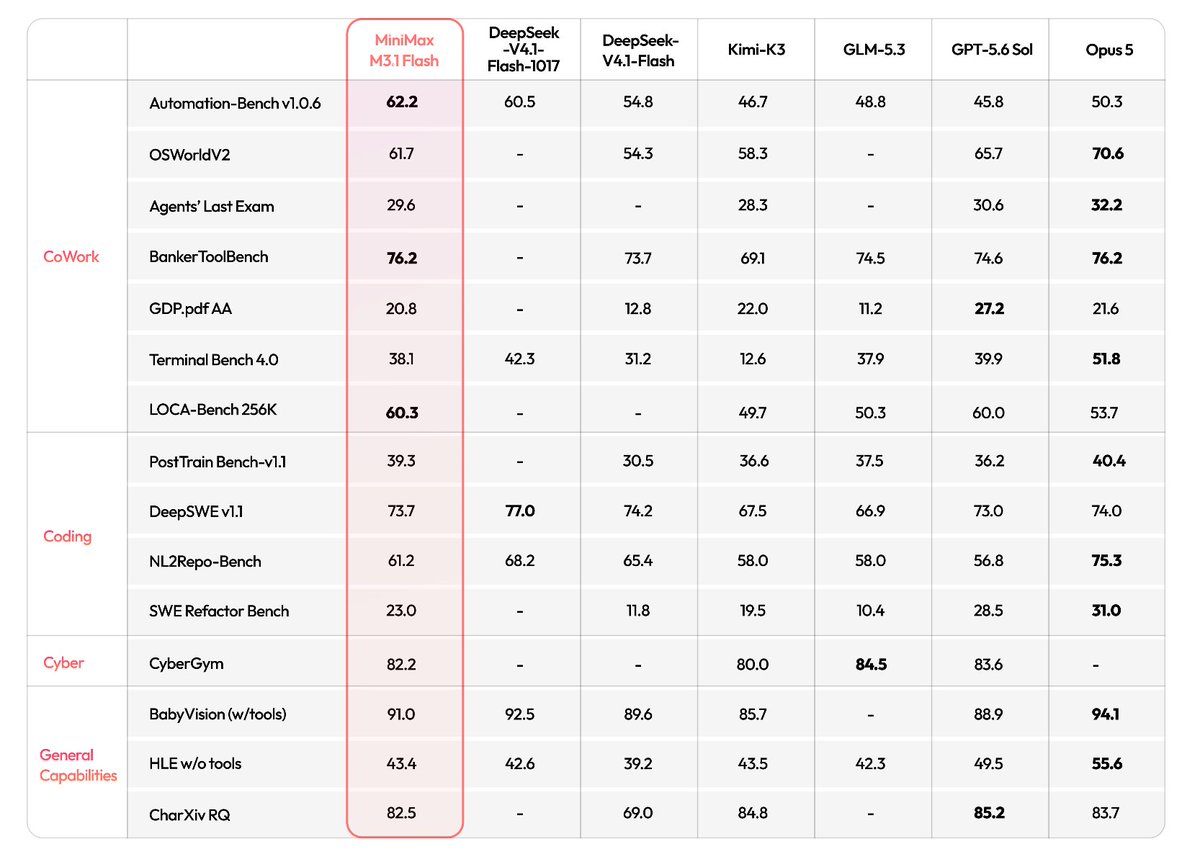
A reposted test says M3.1 Flash has strong design capabilities and costs about 88 times less than Claude Opus 5.5.
Speculative decoding for local speedups
A Local AI tutorial explains how speculative decoding yields large local inference speedups.
AI factories learn grid peak-shaving
At the OCP Summit, Ian Buck showed how AI factories can shed power load and shift workloads when the grid needs relief.
A real-time video interface
Runway's research design studio showed an OS prototype that visualizes agent steps and lets objects enter new worlds.
Claude Haiku 5.5 in the selector
Replit's weekly update adds Claude Haiku 5.5 and enterprise bring-your-own-cloud deployment options.
Day-0 support for Ming-3.0
vLLM-Omni now serves five Ming-3.0 speech models spanning TTS, audio understanding and ASR.
Speculators v0.9.0
A fused loss kernel and FP8 hidden states make speculative-decoding training up to 2x faster with half the storage.
D3 tops the decision boards
All six D3 models ranked first on the Jev Decision Index text and vision leaderboards.
SPACE joins Crusoe
Perplexity's open-source sandbox platform SPACE will become part of Crusoe's managed AI products.
Act3D lets VLMs explore in 3D
From a single image, Act3D uses outcome-only RL to decide when and how to move through 3D scenes.
Dream-1 robot foundation model
Dream Labs exits stealth with a foundation model for controlling bimanual robots.
Rethinking the intelligence explosion
Ramez Naam argues self-improvement loops would need to be 5 to 10 times stronger to sustain an uncontrolled takeoff.
Claude Projects for multi-agent work
Coordinator models and independent agent threads pass messages around.
A public benefit fund
Anthropic pledges a portion of shares to a new public-interest entity.
Three mystery aurora models
aurora-red, green and blue alpha appear in the OpenAI API.