Anthropic's Dynamic Permission Model for AI Agents
Permissions should evolve with agent capabilities and be constrained through sandbox mechanisms that limit destructive actions.
Anthropic published a new engineering blog detailing how it manages access and permissions for AI agents across its product suite. The central principle: permissions granted to agents should dynamically adjust as their capabilities improve rather than remaining static. The company uses sandboxing as its primary mechanism to constrain the scope of potentially destructive actions, creating a safety boundary that prevents an agent from exceeding its authorized limits even when it discovers novel ways to accomplish tasks. The architecture ensures that an agent operating within a product cannot access or modify systems, data or configurations beyond its explicitly granted scope. The blog situates this work within Anthropic's broader mission to build AI systems that are reliable, interpretable and steerable by design.
NVIDIA Vera CPU Delivers 1.5× Lead Over x86 in Benchmarks

NVIDIA released independent benchmarks for its Vera CPU, built specifically for agentic AI workloads. Testing by Phoronix confirms a 1.5× overall performance advantage over the leading x86 processors, with the chip delivering 2× faster Linux kernel compilation and 4× greater STREAM TRIAD memory bandwidth. The results position Vera as a credible data center CPU entrant, leveraging NVIDIA's deep expertise in high-bandwidth memory architectures cultivated through GPU design. The performance delta is particularly significant for AI infrastructure operators who require balanced compute across CPU and GPU resources for serving large-scale agentic workloads.
Claude Code Ships Security Guidance Plugin
A new plugin that identifies and helps fix vulnerabilities during active coding sessions, available to all Claude Code users through the plugin marketplace with a simple /plugins installation flow. The tool scans code as it is being written, surfacing potential security issues before they make it into production.
Tencent Hunyuan Opens Hy-MT2 Translation Model Under Apache 2.0
The Hy-MT2 model is now available under the Apache 2.0 license, granting unrestricted freedom for research, commercial use, fine-tuning and derivative works without strings attached. The move pushes enterprise-grade translation capabilities into the broader open-source ecosystem.
Runway's Project Luxo Declares AI Video Beyond the Uncanny Valley
Runway shared a series of short films produced under Project Luxo with Hollywood executives, producers, directors, writers and actors over recent weeks. The response from industry professionals suggests AI-generated video has now crossed the threshold of the uncanny valley, achieving a level of visual fidelity that audiences accept as natural.
EAGLE 3.1 Advances Speculative Decoding with FC Normalization
The next evolution of speculative decoding introduces new fully-connected normalization techniques to further improve efficiency. Developed by the EAGLE team in collaboration with vLLM and TorchSpec, the release pushes the frontier of inference acceleration for large language models.
vLLM Rust Frontend Merged as Drop-In Replacement for Python API Server
As GPU performance accelerates, the API server frontend has grown into a meaningful share of total CPU time. The new Rust frontend runs as a drop-in alternative using the same engine and ZMQ boundary, activated via a single environment variable to deliver significant CPU efficiency gains.
M3 Rumored to Adopt Block-Level Sparse Attention Design
Speculation points to the next model generation adopting a block-based sparse attention mechanism resembling a streamlined and simplified version of NSA. The development suggests that major labs are systematically mapping out the design space for attention architectures.
Opus 4.5 Matches DeepSeek V4 Pro on ARC-AGI-2
According to the CAIS Capabilities Index, Opus 4.5 and DeepSeek V4 Pro perform at roughly the same level on ARC-AGI-2, while Kimi 2.5 scores 10.8%. The data shows a six-month gap between model releases with meaningful capability differentiation at the top tier.
AI systems that appear objective still encode the cultural biases of their designers. The challenge of building trustworthy models is not merely technical — it reaches into questions of human dignity, explainability and the moral limits of automation.
China Imposes Overseas Travel Restrictions on Top AI Talent
China has begun restricting international travel for elite AI researchers at key organizations, expanding a practice previously rumored to apply only to employees at DeepSeek. The policy marks an escalation in the global competition for AI talent and know-how retention.
Codex with GPT-5.5 Helps Databricks Parse Complex Customer Documents
OpenAI published a case study demonstrating that GPT-5.5 running inside Codex enables Databricks to parse complex and inconsistently formatted customer documents more reliably than previous approaches, reducing manual data extraction overhead.
CHI-Bench: First Long-Horizon Healthcare Benchmark for AI Agents
Released on Hugging Face, CHI-Bench contains 75 real-world long-term medical tasks designed to evaluate agent performance across extended clinical workflows, filling a significant gap in agent evaluation methodology.
PrismML Releases 1-Bit and Ternary Bonsai Image 4B Models
A new family of mobile-friendly image-generation models uses extreme quantization — 1-bit and ternary representations — to deliver high-quality image synthesis on resource-constrained edge devices without cloud dependency.
NVIDIA PiD Enables 4× Super-Resolution Directly from Model Latents
PiD operates entirely in pixel space, performing 4× super-resolution on any generated image by working from the model's latent representations rather than post-processing outputs. The approach eliminates artifacts common in upscaling pipelines.
AI Cannot Reliably Predict Scientific Breakthroughs, CUSP Benchmark Finds
Researchers constructed the CUSP benchmark spanning 4,760 scientific events to evaluate frontier models on feasibility assessment, mechanistic reasoning, experimental design and temporal forecasting. Current AI can identify plausible research directions but fails to predict whether breakthroughs will materialize, exhibiting systematic overconfidence and unreliable uncertainty estimates across biology, chemistry and physics.
MiniMax Debuts New Sparse Attention Architecture
The new sparse attention mechanism is based on grouped-query attention rather than multi-head latent attention, with block-level design choices that differentiate it from DeepSeek V3.2 (DSA) and V4 (CSA) approaches. All major labs are now converging on sparse attention as the next architectural frontier.
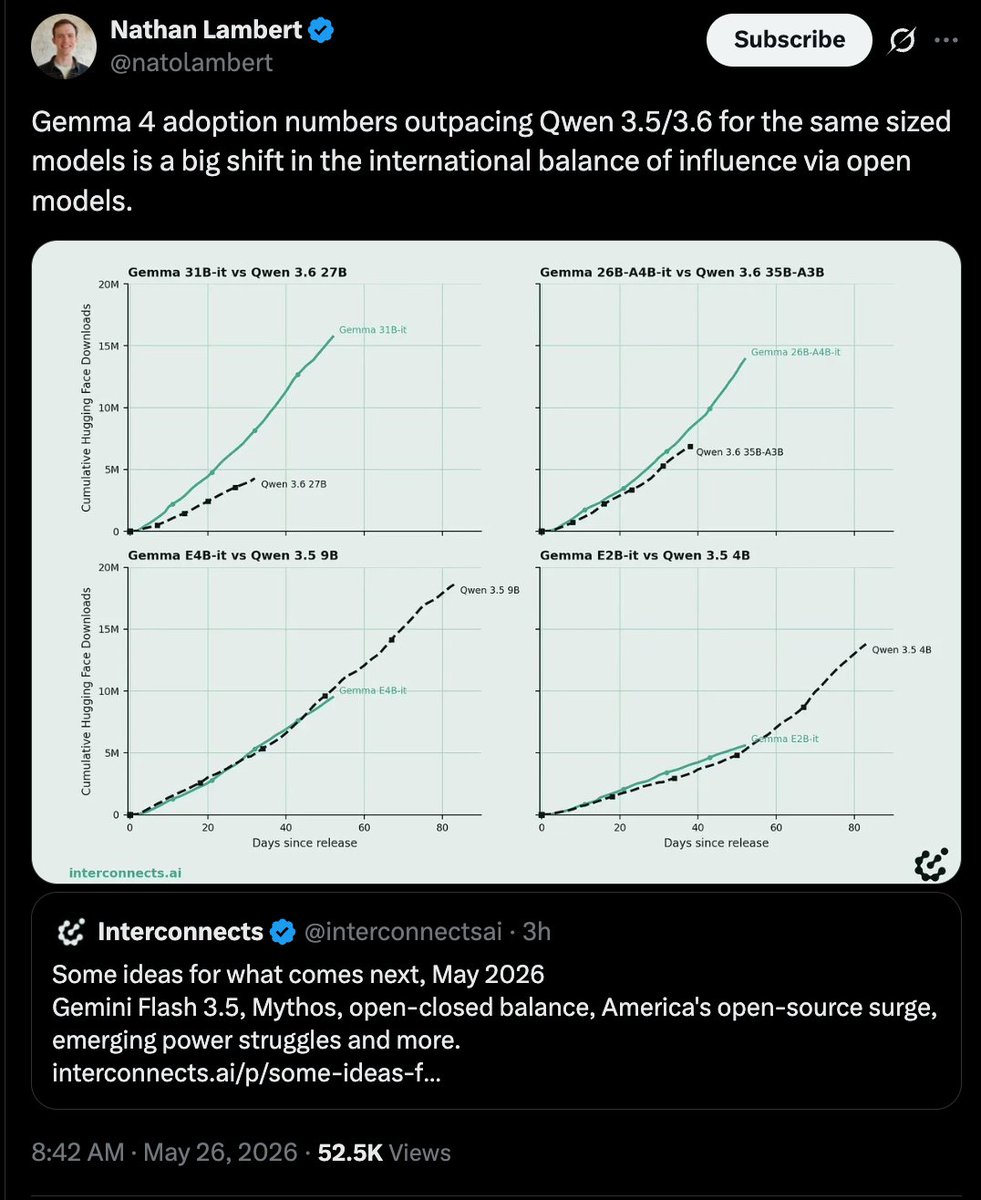
Gemma 4 Adoption Surpasses Qwen 3.5 and 3.6, Reshaping Open Model Influence
New data indicates that for similarly-sized models, Gemma 4 adoption rates have outpaced Qwen 3.5 and 3.6, signaling a significant shift in the international balance of influence delivered through open-weight models. The trend suggests European and American open models are regaining momentum in markets where Chinese models previously dominated.
Marlin-2B Open Video VLM Understands Event Timing
A compact Apache 2.0 video vision-language model that identifies not just what happens in video but also when events occur in the temporal stream.
Carbon DNA Model Technical Report Published on bioRxiv
Detailed training recipes for fully open and efficient DNA models, advancing the frontier of biological sequence modeling.
How to Properly Evaluate AI Agents: A Step-by-Step Guide
A practical framework starting from defining success criteria, moving through structured evaluation informed by best practices from recent research on agent assessment.
ElevenLabs Music v2 Delivers Stronger Vocals and Multilingual Gen
Improved vocal quality, instrumental arrangement and orchestration across genres with enhanced multilingual support for global music creation.
mKernel: Fast Multi-Node Multi-GPU Fused Kernels Open-Sourced
A library of optimized fused kernel operations enabling efficient collaborative computation across distributed GPU configurations.
Kimi Leads Open-Source Autonomous SWE Agents, DeepSeek Needs Handholding
Among open models, Kimi is closest to a mature autonomous software engineering agent, while DeepSeek shows isolated strength in debugging but requires more guidance.
Ethan Mollick on What Tasks to Keep Human and What to Hand Over to AI
Drawing on education experiments, consulting practice and a recent literary award controversy, the essay explores the boundary between human judgment and machine delegation in the age of generative AI.
No Reliable Study Yet on Autonomous Coding Tool Productivity
Ethan Mollick notes that every existing paper on coding productivity predates the Claude Code and Codex revolution of late 2025, creating a significant knowledge gap about what is actually happening in software engineering workflows.
Google DeepMind Unveils Gemini for Science Tools
AI-powered discovery tools spanning biology, chemistry and physics designed to help scientists accelerate their next breakthrough.
RAG and AI Agent Evolution: A Comprehensive Review from 2023 to 2026
LlamaIndex founder delivered a 90-minute lecture tracing the trajectory of retrieval-augmented generation, document context management, and autonomous agent architectures over three pivotal years.
Pika Launches Generative UI: Voice-Controlled Interface Creation
An experimental project where an agent listens, analyzes context and determines the most appropriate visual composition dynamically from voice commands alone.
Poolside AI Publishes Technical Report for Agentic Coding Models
LAGUNA M.1 packs 225.8B total parameters with 23.4B active per token; the smaller XS.2 runs 33.4B total with 3B active. Both MoE models were trained from scratch for long-context coding.
Parallel Agents Don't Scale Cleanly for Math and Physics Problems
Experiments with Codex reveal many research problems are inherently sequential; spawning dozens of parallel agents does not accelerate discovery in a linear fashion.
Krea Seedance 2.0 Now Unlimited for Pro and Above Members
Competition in the AI creative tools space intensifies as Krea removes usage caps on its latest video generation model for paid tiers.
Stack Overflow Posts Plummet to 2008 Levels as AI Tools Take Over
Only 6,866 new questions last month — matching the site's early days — yet the company reports paradoxically higher revenue despite the cratering post volume.
Infinite Context Windows Create Cognitive Fatigue for AI Users
Ethan Mollick argues that today's models already leak excessive old information into current responses, making them cognitively exhausting to use — and infinite contexts would worsen the problem.
The Key Difference Between Agent Apps and Traditional App+AI: Who Executes
In agent applications, humans direct AI to operate the application autonomously; in traditional App+AI, humans operate the app while AI merely assists with suggestions.
LlamaParse Automates Loan Underwriting
A few lines of code parse pay stubs and brokerage statements in any format, eliminating manual data entry from the underwriting pipeline.
Kaifu Lee and Tom Mitchell Reflect on 45 Years in AI
A Stanford Digital Economy Lab conversation traces Lee's entry into AI and his persistence across nearly half a century of field evolution.
Cohere Studio Turns AI Ideas into Physical Merchandise
Small-batch production of clothing and objects inspired by language model concepts, exploring the cultural dimensions of AI.
AI Supply and Demand Near Equilibrium
Ethan Mollick observes rising demand driving higher costs, yet enterprises show no sign of finding AI less valuable over time.
Hugging Face Publishes 1 Trillion Token Synthetic Data Methodology
Available slides detail the pipeline for generating one trillion tokens of synthetic training data at industrial scale.
Paul Graham: AI-Written Emails Signed by Humans Feel Like Deception
PG says he has never knowingly finished reading an email written by AI but attributed to a person, comparing the experience to being lied to.
US Also Catching Up to China in Key AI Domains
The popular narrative focuses on China closing the gap with the US, but the reverse story is also unfolding as American labs advance in areas where Chinese models previously led.
Natolambert Calls for Release of Gemma 4 100B MoE Model
With Gemini Flash 3.5 now public, the argument is that Google should release the full 100B MoE Gemma 4 model to the open-source community.
Big Model Controllers Will Hold Insane Soft Power
Francois Fleuret warns that nations controlling the largest AI models will wield geopolitical influence far beyond the technology sector alone.