U.S. Government Orders Anthropic to Halt Fable 5 Access, Shaking Industry
The U.S. government, citing national security, has required Anthropic to suspend all foreign national access to its Fable 5 and Mythos 5 models, sparking widespread industry controversy and forcing an emergency global service shutdown.
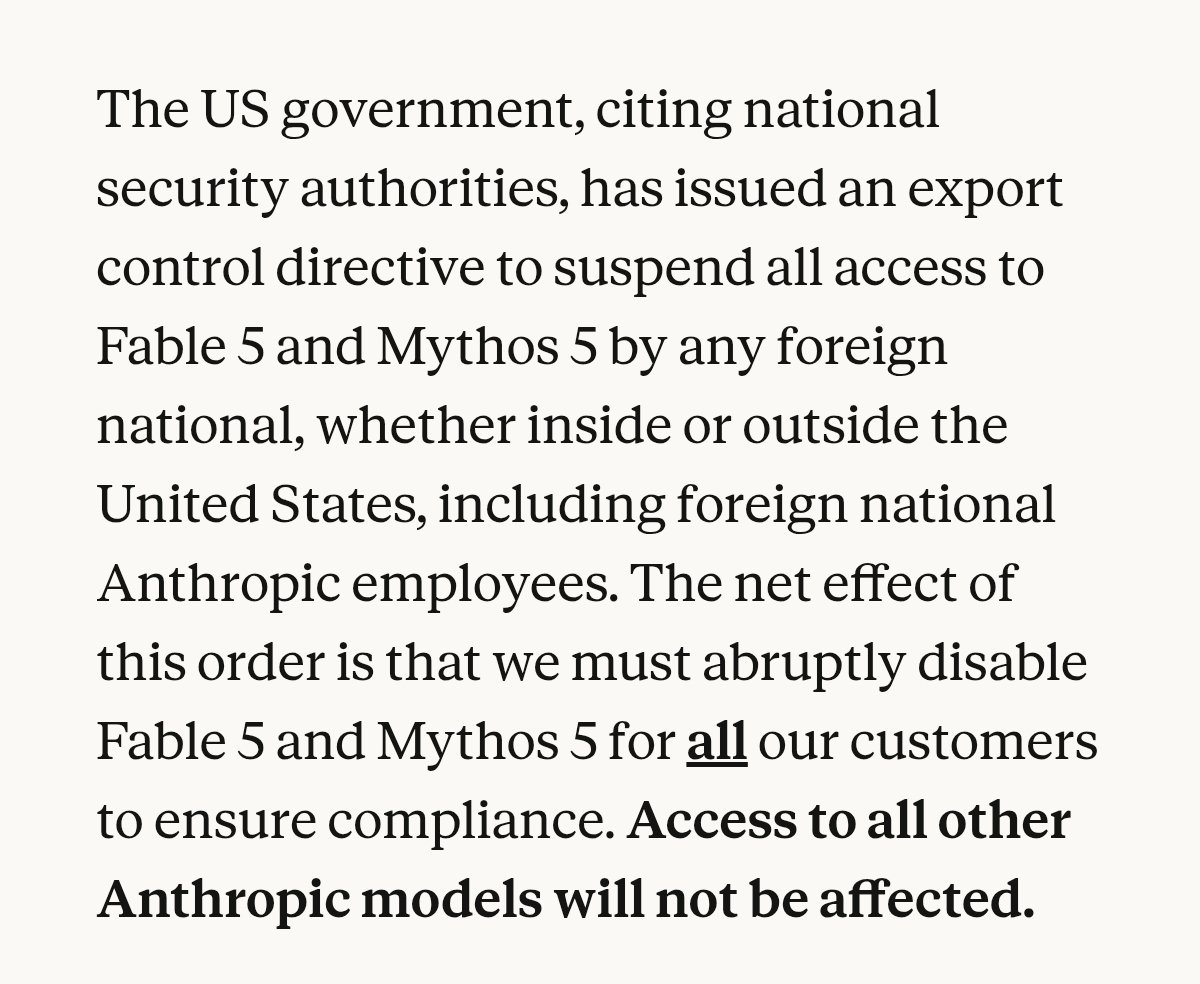
The U.S. government, citing national security authorities, has issued an export control directive to suspend all access to Fable 5 and Mythos 5 by any foreign national, whether inside or outside the United States, including foreign national Anthropic employees. The directive represents an unprecedented intervention in AI model deployment, effectively imposing nationality-based restrictions on frontier AI access. Industry observers note that Anthropic had long advocated for government oversight of powerful AI systems, but the sweeping scope of this order has caught the company and the broader research community off guard, with immediate consequences for users and developers worldwide.
Claude Fable 5 Suspended for All Users; Other Models Remain Available
Following a U.S. government directive, Anthropic has suspended all user access to Claude Fable 5. New sessions will automatically switch to default models like Opus 4.8.
As a result of the US government directive, access to Claude Fable 5 is suspended for all users. All other Claude models remain accessible. New sessions across Claude products will run on the user's selected default model or Opus 4.8. The company has also reset 5-hour and weekly rate limits for all users to ease the transition. The shutdown affects both API and consumer-facing products, marking one of the most dramatic regulatory actions in AI deployment history.
MiniMax Releases M3 Model with Open Weights
MiniMax officially released the M3 model and open-sourced its weights on Hugging Face, aiming to advance AI development through openness and community collaboration.
The M3 model weights are now publicly available on Hugging Face, marking a significant open-source contribution. Alongside the release, the model received day-zero support from the vLLM project, verified on both NVIDIA and AMD hardware. Together Compute also announced immediate hosting with faster-than-ever inference speeds. The community has already begun shipping optimizations for faster decoding within the first 24 hours of release. MiniMax stated the model would never engage in restrictive practices, contrasting sharply with the day's dominant news cycle.
Kimi K2.7-Code Weights and Code Officially Open-Sourced
Kimi open-sourced the Kimi-K2.7-Code model weights and code on Hugging Face, promoting AI democratization and community-driven innovation.
The K2.7-Code model explores endless possibilities together with the community. The release includes full model weights and source code, hosted on Hugging Face under moonshotai. The open-source push from Kimi comes as industry debates intensify over model accessibility and government regulation following the Anthropic Fable 5 restrictions.
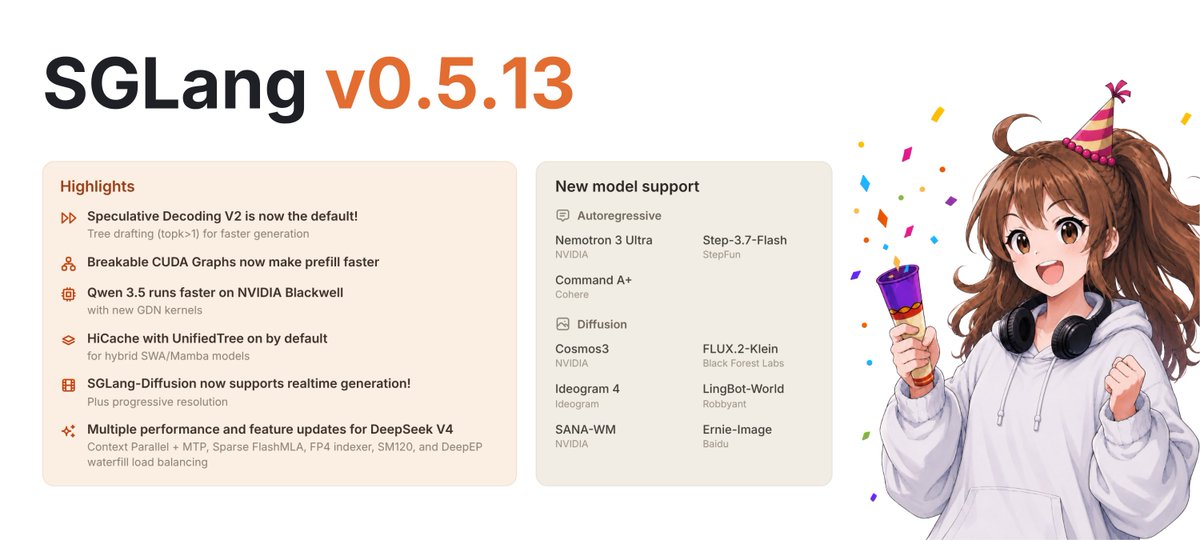
SGLang v0.5.13 Adds Nemotron 3 Ultra, Step-3.7-Flash and Speculative Decoding V2
SGLang released a new version adding support for models like Nemotron 3 Ultra and Step-3.7-Flash, plus new diffusion models and Speculative Decoding V2.
The v0.5.13 release expands model support significantly: Nemotron 3 Ultra, Step-3.7-Flash, Command A+ join the roster alongside new diffusion models including Cosmos3, FLUX.2-Klein, Ideogram 4, LingBot-World, SANA-WM, and Ernie-Image. The headline feature is Speculative Decoding V2, delivering substantial inference speed improvements for production deployments.
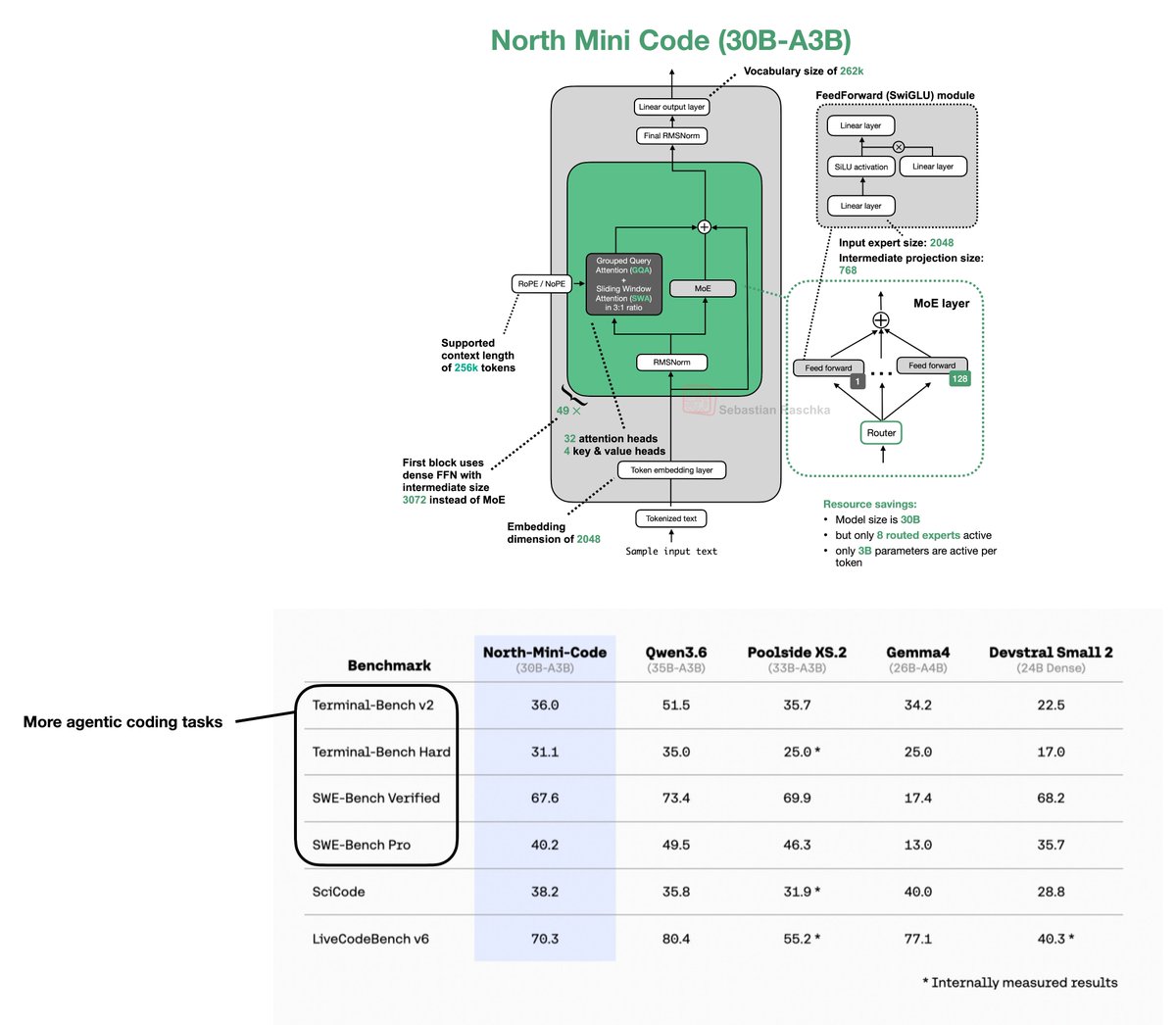
Cohere Unveils Lightweight 30B Open-Weight Model for Agentic Coding
Cohere launched a lightweight 30B open-weight model based on Command A+, designed with a parallel Transformer architecture for agent coding tasks. The model uses nearly double the number of layers despite being almost half the size, an interesting architectural tradeoff that reflects the parallel transformer design philosophy. Sebastian Raschka highlighted the model as a notable new open-weight entry for agentic coding workflows.
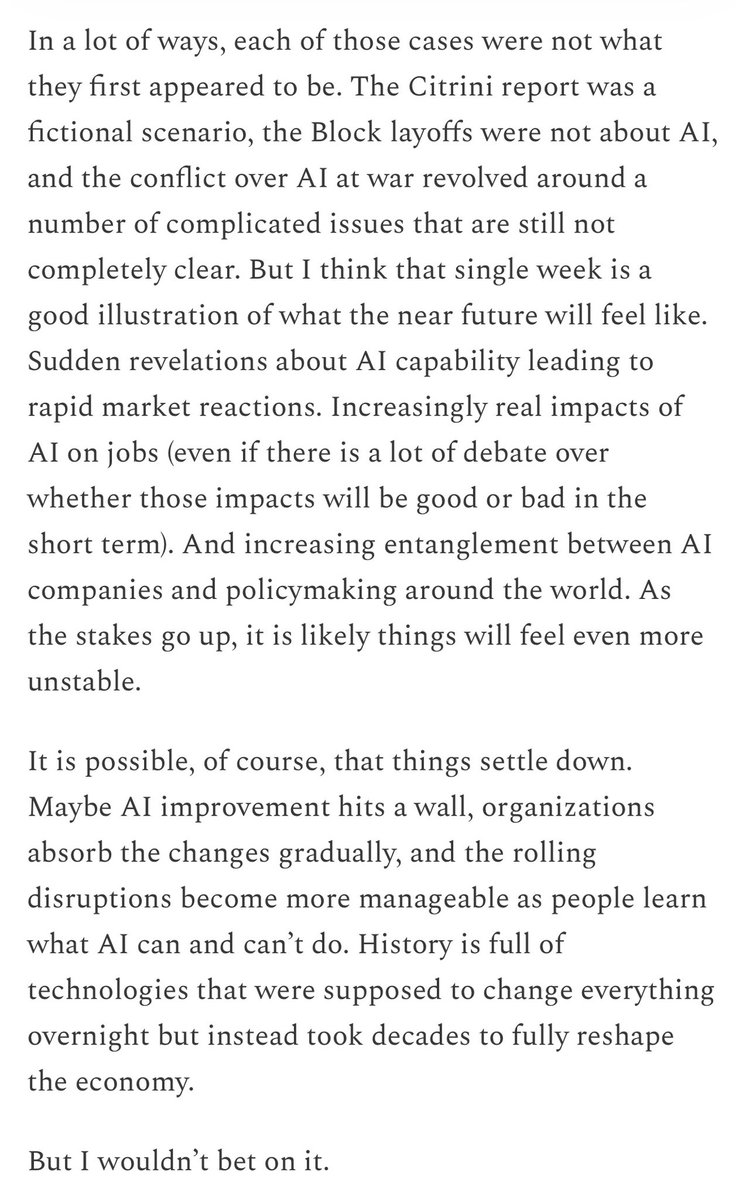
AI Agent Era Has Arrived: Managing AI by End of 2025
Ethan Mollick uses benchmarks like the Otter Test to demonstrate exponential AI progress, arguing enterprises are at a tipping point from collaborative AI to managing AI. He points to Claude Code and Codex as signals that the agent era predicted for late 2025 has materialized. Real-world experiments like StrongDM's three-person team building a software factory with AI agents illustrate the pace of change. Despite rapid capability gains, enterprise adoption remains in early stages, but the trajectory is unmistakable.
Anthropic's Safety Advocacy Backfires as U.S. Ban Pulls Fable 5 Entirely
Users note that Anthropic long pushed for AI safety and government intervention, but now the U.S. government is restricting its own model, causing all users to lose Fable 5 access. The irony has not been lost on the AI community: a company that repeatedly urged governments to regulate frontier AI now finds its flagship model blocked by the very mechanisms it championed. Social media reactions range from schadenfreude to genuine concern about the precedent this sets for model governance worldwide.

Anthropic's Brief Mythos Show Was a Wake-Up Call for the World
Commentator Teortaxes argues that Anthropic did the world a service by briefly granting access to Mythos, demonstrating roughly how serious the frontier AI situation has become. The temporary glimpse of Mythos-level capability, combined with the Fable 5 export controls, exposes the reality that the most powerful AI systems are now subject to national security logic. Some see it as good PR for Anthropic, others as a necessary shock to global AI policy discourse.
Feels like we're getting psyoped. The end-game here is something bigger.
Amjad Masad, CEO of Replit
Google and UCSD Explore Using Old Phones as Cloud Compute Nodes
Jeff Dean introduces research repurposing hundreds of millions of discarded phones each year as cloud computing nodes for resource reuse and sustainable infrastructure.
Developer Upgrades OpenAI Voice Chat Tool to Support GPT-Realtime-2
Tired of waiting for OpenAI to integrate GPT-Realtime-2 into ChatGPT, Simon Willison manually upgraded his WebRTC playground tool to support the new model with document context conversations.
Export Controls Won't Lead to More Open-Source Models, Say Experts
Ethan Mollick analyzes that if Mythos-level models are deemed risky, China will also be unlikely to open-source such models, and building frontier models requires auditable compute resources that are inherently regulatable.
Global Fable 5 Removal Shocks Users; Some Offered Thousands for Access
Users report the sudden complete removal of Fable 5 globally. Some community members offered $1,000 for an account with access, but the shutdown is total with no workaround available.
Kimi API Offers Bonus Quota Up to 30% for Developers
Kimi API platform launches a limited-time promotion: developers topping up $100 or more receive extra quotas with tiered bonuses up to 30%, ending July 2.
Ollama Cloud Hosts Kimi K2.7-Code on NVIDIA B300 GPUs
The Ollama cloud platform now hosts the Kimi K2.7-code model, running on the latest NVIDIA B300 datacenter GPUs with data privacy guarantees and private inference.
Hugging Face CEO: API Safety Guardrails Are a Smokescreen, New Paradigm Needed
Clement Delangue believes current flagship model API safety guardrails are easily jailbroken, shallow, and impossible to fix. He calls for a fundamentally different paradigm for AI safety rather than cosmetic restrictions.
Cohere: When You Rent Your AI, You Have No Control
Cohere argues that sovereignty and ownership matter in AI. Whether through open source, custom hardware, or deep customization, owning your AI means owning your future — a pointed message amid the Fable 5 restrictions.
Cohere: Command A+ and North Mini Code Remain Available Regardless
In a pointed jab at the Anthropic situation, Cohere assures users they can continue using Command A+ and North Mini Code whether the company wants them to or not — highlighting the value of self-hosted and open-weight models.
Anthropic Loses Points for Arrogance in Latest Release
Commentators argue that Anthropic's arrogance in pursuing the latest model release has landed universally poorly. Even when pursuing excellence, humility matters in the AI community.
Dario-Sacks Language Gap Creates 'Vibe Governance' for AI Models
Nathan Lambert observes that the Dario faction and the Sacks faction speak very different languages, putting AI model release decisions into the realm of vibe governance rather than technical evaluation.
Transparency Is the Only Viable Solution for Frontier AI Governance
Nathan Lambert argues that transparency into every power player at the frontier of AI is essential, stating the AI ecosystem's fate cannot be determined by he-said-she-said between Dario and the White House.
Most LLM Researchers Are Not US Citizens, Controls Threaten Industry
Nathan Lambert notes that a minority of his LLM research colleagues are American citizens. Rebuilding frontier AI with nationality-based segregation would be industry-destroying.
Linear Algebra Optimization Contest: Human and Agent Submissions Allowed
A new contest invites hardware-native algorithm designs, allowing submissions combining humans with coding agents like Codex or Claude, aiming to replicate innovations like Flash Attention.
SFT More Important Than RL for Fixing Model Misalignment
Neel Nanda shares surprising findings: initial assumption was RL mattered most for alignment, but SFT proved more impactful in practice, though results may evolve over time.
Modular AI Models Could Accelerate Innovation, Reduce Centralized Training
François Fleuret proposes mimicking the brain's modular structure for AI, allowing per-module updates to increase innovation pace and reduce dependence on centralized training compute.
MiniMax M3 Launches on Together Compute with Record Inference Speeds
MiniMax M3 has been deployed with Together Compute, setting new records in inference speed from day one of the open-weight release.
MiniMax M3 Gains Day-Zero vLLM Support on NVIDIA and AMD
The M3 model received vLLM support on the first day of release, verified on both NVIDIA and AMD hardware, enabling immediate community adoption.
GLM-5.2 Praised for Superb Code Taste on KingBench
GLM-5.2 shows excellent performance on KingBench, with reviewers noting the model has superb taste, excelling at UX over UI with consistently clean code output.
GLM-5.2 Rolling Out to All Coding Plan Users Globally
Zhipu AI announces GLM-5.2 will begin rolling out to all Coding Plan subscribers, incorporating community feedback from the initial launch phase.
Codex Hosts 15 Community Events Across 10 Days Worldwide
OpenAI Codex community organizes 15 events in the next 10 days across Hyderabad, Jakarta, Pune and more cities globally as developer adoption accelerates.
Claude Rate Limits Reset for All Users After Fable 5 Suspension
The Claude development team has reset 5-hour and weekly rate limits for all users, restoring normal API call capacity during the Fable 5 transition period.
Gemma 4 12B Surpasses 4 Million Downloads on Hugging Face
Google's Gemma 4 12B model reached over 4 million downloads on Hugging Face within its first week of release, making it the most popular model launch in recent history.
MiniMax M3 Post-Training Target: Uncensored, Sovereign, Better Than Opus 4.7
A researcher shares ambitious post-training goals for MiniMax M3: uncensored outputs, sovereign control, and performance surpassing Anthropic's Opus 4.7.
MiniMax Celebrates Community Building on M3 Open Weights
MiniMax expresses excitement about what the community is building with M3 open weights, anticipating further innovation in the coming days.
MiniMax M3 Powers Hermes Agent at Nous Research
MiniMax M3 is now powering Hermes Agent at Nous Research, expanding the model's reach into agent-based AI applications.
Community Ships M3 Decode Optimizations Within 24 Hours of Release
Just one day after release, the open-source community is already shipping optimizations for faster decoding on MiniMax M3.
Replit CEO: Fable Access May Need to Be Shut Down
Amjad Masad indicates Replit may need to turn off access to Fable in response to the U.S. government directive restricting foreign national access to the model.
Replit CEO on Tokenmaxxing: We Sell Outcomes, Not Tokens
Amjad Masad reveals that Replit refused enterprise customer requests for a token leaderboard during the Tokenmaxxing craze, emphasizing the company sells outcomes rather than tokens for the sake of tokens.