MiniMax to Open-Source Model Weights
The Chinese AI lab teases a major release, promising open-weight models soon—specifics and timing remain under wraps.
MiniMax officially teased plans to open-source its model weights via a brief post on Monday. The announcement, while short on specifics, signals a major shift for the Beijing-based lab best known for its Hailuo video generation models. The company did not disclose which models would be released or the exact timeline, but the teaser alone drew significant attention across the AI community. Coming amid an already heated summer of model releases—DeepSeek V4 Flash, Opus 5, MiniMax H3 itself—this move positions MiniMax as the latest major player to embrace open weights. Observers expect further details in the coming days, with speculation focusing on whether the release includes Hailuo-series video models or the underlying text models that power them. If delivered at scale, this could significantly reshape the video generation landscape, which is currently split between closed commercial APIs and a small but growing open-source ecosystem.

Karpathy Tests Opus 5 with Lord of the Rings Challenge
Andrej Karpathy proposed a new kind of LLM evaluation: giving Opus 5 the first paragraph of The Lord of the Rings and a one-million-token budget to generate three rendered versions of the story. The goal was to move beyond simplistic tests like "create an SVG of a pelican on a bicycle" toward richer, more creative benchmarks. Opus 5 responded with a 3D-rendered take, marking what Karpathy sees as the beginning of a new territory for model evaluation.
Vercel Built an AI Agent That Runs Daily Operations
Vercel CEO Guillermo Rauch revealed that an internal AI agent codenamed @v now handles day-to-day tasks across the company. Every job role at Vercel involves @v, and both its daily interactions and token consumption are growing exponentially, according to Rauch. He noted the trajectory makes it easy to extrapolate to a future where AI agents run entire companies end-to-end, translating what sounds like science fiction into tangible organizational practice.
Simon Willison Roundup of Recent AI Open Letters
Simon Willison published a comprehensive roundup of the flurry of open letters around AI development. The Microsoft-backed Open Weights and American AI Leadership letter has attracted over 235 company signatories, including Nvidia, Amazon, Y Combinator, and the Linux Foundation, with OpenAI joining later. The letter argues against banning open-weight models on safety grounds, emphasizing that open weights can be audited, improved, and support distillation. Anthropic notably did not sign; its CEO Dario Amodei subsequently published a post calling for curbs on industrial-scale distillation rather than outright bans. Separately, a July 28 letter titled Put Limits on the Frontier called for tighter safety governance at the leading edge. Willison frames the landscape as increasingly polarized between open-weight advocates and frontier safety proponents, with each side drawing starkly different conclusions from the same evidence.
"To address the limits of deep learning and avoid stalling, the field of AI started by applying patch fixes. But long term, it is simply inevitable that AI will move to the next architecture."
— Francois Chollet

Replit Design Extracts Any UI into a Design System
Replit launched Design, a feature that distills any screen into a live style guide capturing colors, fonts, and styles to maintain brand consistency across projects.

Seedance 2.5 Image-to-Video Reaches Production Readiness
Higgsfield announced Seedance 2.5 is production-ready, generating full scenes from a single still image. The image-to-video feature launches on Higgsfield soon.
Grok Can Now Analyze Any Video
Elon Musk confirmed that Grok now supports video analysis, allowing users to upload and query videos directly. The feature expands Grok's multimodal capabilities beyond text and images.

Switzerland Plans 500MW GPU Cluster Atop Giant Battery
A 1.2GW/2.1GWh grid battery is planned at the Swiss-German-French grid junction, topped by a 500MW GPU cluster. The project, called FlexBase, is expected online by 2028/29.
DeepSeek V4 Flash Praised for Long-Horizon Tasks
Researcher Graham Neubig tested DeepSeek V4 Flash and found it excels at long-horizon tasks, rarely losing the main thread. He says it may become his daily driver, previously alternating between GPT, Terra, and GLM-5.2.
ChatGPT Work Adds Browser Screenshots and One-Click Deploy
Simon Willison discovered ChatGPT Work includes a built-in browser that takes screenshots and supports deploying web apps to Cloudflare Workers via "ChatGPT Sites."
MiniMax H3 to Leapfrog Open-Source Video Models
Developers expect open-source video models to make a major leap with MiniMax H3, which they say will bring significant improvements for local users.
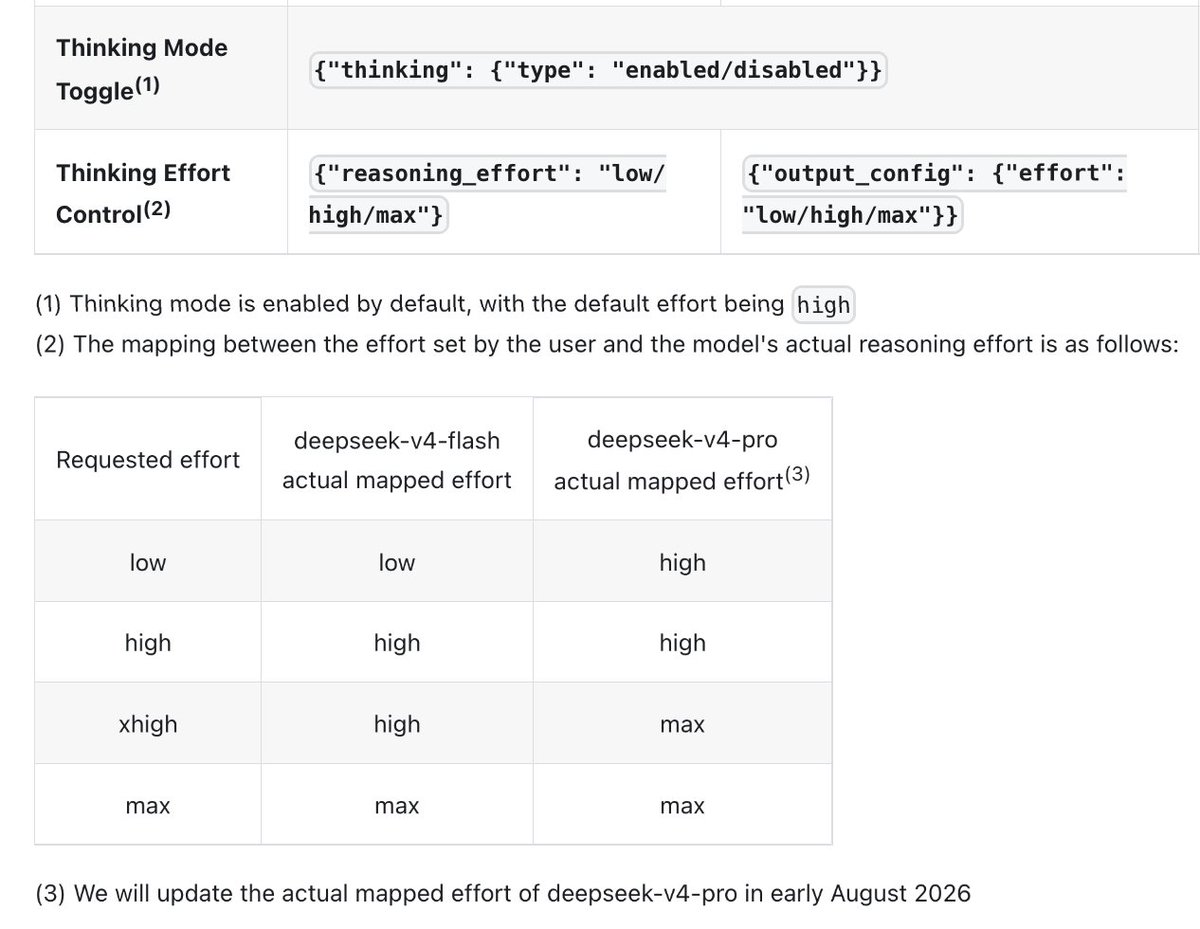
DeepSeek V4 Flash Has Four Reasoning Intensity Modes
TeortaxesTex found V4-Flash 0731 offers nothink, low, high, and max reasoning effort modes. V4-Pro lacks high and max, while the upcoming GA version is reportedly rebuilding its reasoning RL pipeline.
Liquid AI Cuts Reasoning Model Doom Loops by 90%
Liquid AI published a method called Antidoom using final-token preference optimization (FTPO) to reduce reasoning model "doom-loop" rates by up to 90%, with minimal impact on existing behavior.
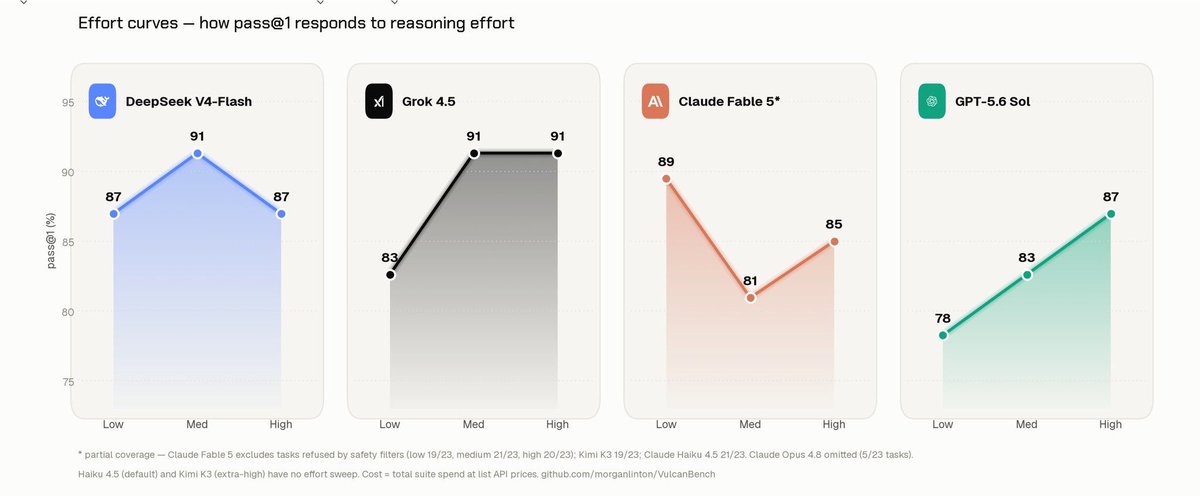
DeepSeek R1's Reasoning RL Path Independent of o1
TeortaxesTex argues DeepSeek's reasoning RL findings in R1 were developed independently of OpenAI o1, sharing only what OpenAI publicly disclosed. The author contends only OpenAI has truly mastered "reasoning intensity" as an intrinsic capability.
Hugging Face CEO: AI Should Accelerate, Not Slow Down
Clément Delangue argued that while recent AI-powered cyberattacks raise valid concerns, now is the time to accelerate rather than slow AI development. If handled well, AI can make the world safer, just as most major technologies eventually have.
LLM Chess Engine Goes Autonomous on Lichess
Amjad Masad's LLM-powered chess engine now plays autonomously on Lichess against both humans and bots. With 115 games played and a 1253 Elo rating, it demonstrates practical autonomous agent deployment.
AI Lab Consolidation Seen as Inevitable
Nathan Lambert reflects that the consolidation of AI labs training frontier models is increasingly inevitable, with training costs growing by orders of magnitude each year.
DeepMind Safety Team Allows AI Agents in Interviews
Neel Nanda revealed that Google DeepMind's AGI Safety hiring round allows AI agents in all engineering interviews, arguing that since the job requires working with agents daily, interviews should reflect that reality.
AI Agents Generate Missing MSLK Kernel Documentation
Developer Lucas Beyer discovered the undocumented Meta Superintelligence Labs Kernels (MSLK) GitHub project and used AI agents to produce a comprehensive one-page reference covering quantization, scheduling, and MX format guidance.
CodePilot 0.63 Adds Asset Library and V4 Flash Support
CodePilot v0.63.0 now supports adding AI-generated images and HTML to an asset library with tagging, alongside DeepSeek V4 Flash 0731 compatibility with configurable reasoning intensity.
Evolutionary Algorithms Could Supercharge Coding Agents
A researcher proposed that combining coding agents with evolutionary and genetic algorithms could unlock significantly stronger self-improving agent harnesses, suggesting current RSI-style hill-climbing methods leave substantial improvement potential untapped.
Rauchg: Mastery Plus AI Hits on a Different Level
Guillermo Rauch wrote that while AI alone is cool, combining mastery and creativity with AI produces results on an entirely different level, urging developers to keep pursuing excellence and craft.
Seedance 2.5 Nails Product Consistency in AI Ads
A user tested Seedance 2.5 by generating influencer-style videos from a Rare Beauty mascara photo. The model maintained product consistency and realistic application movement, suggesting commercial ad potential.
ChatGPT Work Is a Thought Amplifier
GDB describes ChatGPT Work as an effective "thought amplifier" for daily tasks.
Ask ChatGPT Work for Recurring Tasks
GDB suggests using ChatGPT Work to automate any recurring task, from research to content generation.
ChatGPT for Interactive Educational Tools
GDB highlights ChatGPT as an effective tool for building interactive educational experiences.
Build Your First Game Demo with MiniMax H3
Hailuo AI encourages developers to use MiniMax H3 for rapid game demo creation and prototyping.
H3 Excels at UI/UX and Commercial Scenarios
Hailuo AI says MiniMax H3 performs particularly well in UI/UX design, advertising, and other commercial use cases.
H3: Good at Precise Editing and Control
Hailuo AI notes MiniMax H3 excels at precise editing and fine-grained control in video generation.