
● MODEL RELEASE · OPEN WEIGHTS

Thinking Machines Drops Inkling: a 1T-Parameter Open-Weight Omni Model
Natively multimodal across text, image and audio, with up to 1M tokens of context — and full inference support in vLLM on launch day.
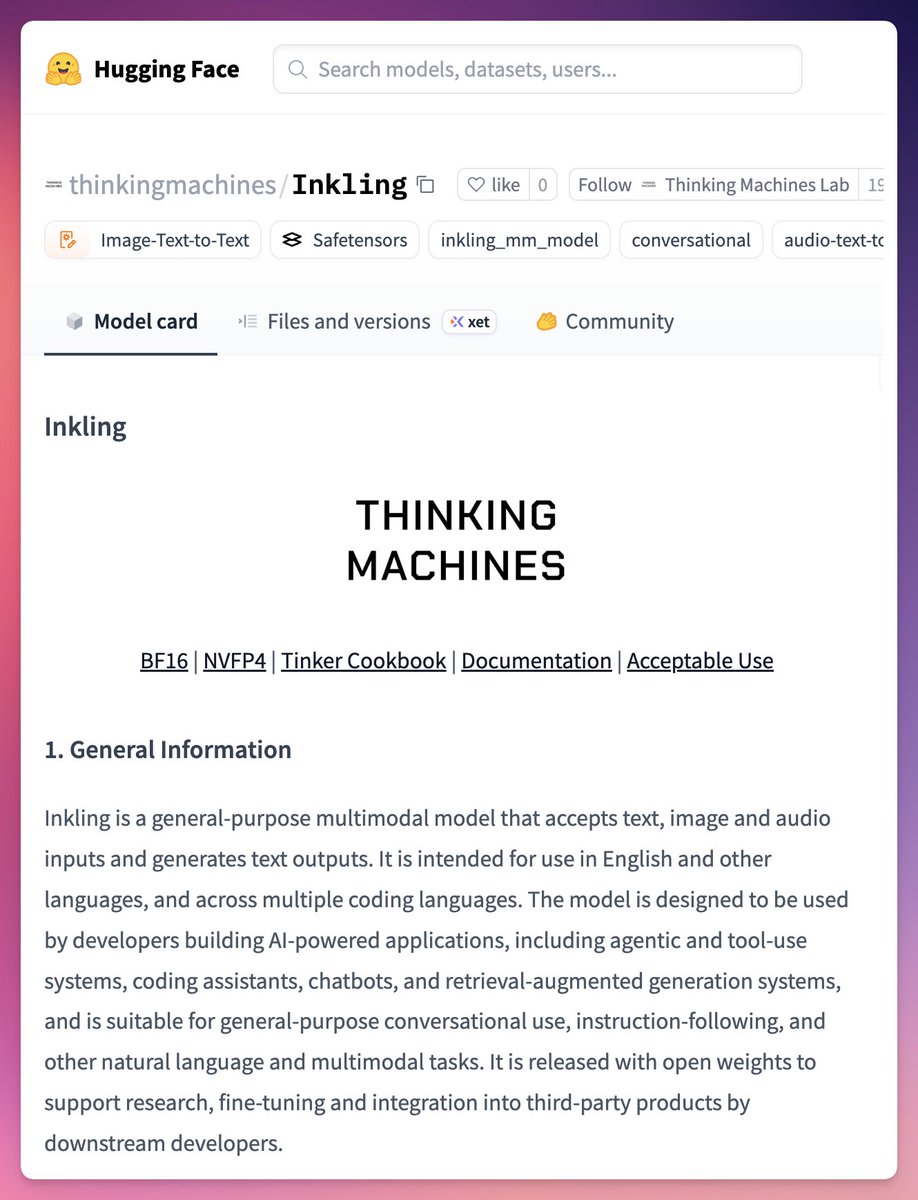
Thinking Machines' first general model landed with unusual completeness for a day-one open release. Inkling is natively multimodal across text, image and audio, stretches to a one-million-token context window, and introduces a new architecture combining relative attention, short convolutions and mixture-of-experts routing. The vLLM project shipped day-zero support, and the weights are live on Hugging Face and Tinker for anyone to fine-tune.
● BENCHMARKS
~1T Parameters, 41B Active, Apache-2 — a Clear Step Past Nemotron Ultra
Nathan Lambert calls the benchmarks a clear step up from Nemotron Ultra (55B active), making Inkling the new best American open model — with omni input to boot. It still trails GLM 5.2 on agentic benchmarks and Kimi K2.6 on multimodal tasks, but the Apache-2 license and the scale of the release reset expectations for what a US lab will give away.
● INSIDE THE BUILD
John Schulman: Pretraining Began Last Winter, a Small Team Did the Rest
Schulman confirms Inkling shipped with open weights and lands in Tinker on day one. Pretraining started last winter; from mid-January a small team layered on the coding, reasoning and agentic training. "We learned a lot building it," he writes — the model was carried from pretraining to post-training entirely in-house.
It truly takes a village to release a model, perhaps especially an open weights model. Doing the entire process from scratch — from data to pretraining to posttraining to actual release — gives a lot of appreciation for anyone who does it.
● THE DISTILLATION DEBATE
"The Only Open-Weight Model Not Distilled from OpenAI or Anthropic"
jxmnop argues people are underestimating the release: Kimi distills, GLM distills, Qwen distills, Nemotron distills — Inkling, by contrast, was trained on a fully independent pipeline, making it a genuinely different lineage in the open-model family tree.
Soumith Chintala: 975B, Natively Multimodal — "It Is Yours"
Available on Tinker, Hugging Face and partner platforms: "It is yours to personalize and use openly. It is yours."
"The Western Open-Source Frontier Is Back"
Teortaxes ranks Inkling on par with the largest known Chinese pretrains — another DSMoE trained partly on Kimi data, but with vision and audio. "Unexpected good news."
SGLang Day 0: Up to 71.7k tok/s Input Throughput on B200
Dedicated kernels for the ShortConv + relative-attention + shared-expert-sink architecture, 171 tok/s per user, plus native 8-layer MTP and DFlash speculative decoding.
Back-of-Envelope: ~1K GB300s, ~1 Week, ~$5M for the Final RL Run
Nathan Lambert's estimate of Inkling's final reinforcement-learning run — "a fun interview question for a post-training lab." Rare to see such numbers discussed in the open.
Sebastian Raschka: Small Conv Layers, Embedding RMSNorm, No RoPE
The architecture hides little surprises: convolutions scattered through the stack, an RMSNorm applied to embeddings before the block norm, and relative position bias in place of RoPE.
Graham Neubig: Continuous Thinking Effort Is "Very Cool"
"I love more players in the arena" — and the framing of Inkling as a model built for customization rather than one-size-fits-all deployment.
"I Like That Inkling Is Mediocre on Benchmarks"
Teortaxes reads the middling scores as evidence the team didn't cut corners with distillation: the independent data pipeline will shine through, and "by the second-third update they become a meaningful player."
"Inevitable Once Tinker Took Off"
Lambert again: integrating post-training services across the entire Thinking Machines stack makes Inkling one of the best open-model business stories to date. Inference companies may be next.
jxmnop Walks It Back: "Apparently They Did Distill — but Only a Tiny Bit"
Hours after crowning Inkling the only non-distilled open model, the follow-up landed. The independent-pipeline story mostly holds, with an asterisk.
● SECURITY
OpenAI Unveils GPT-Red, an Automated Red Teamer for Prompt Injection
An internal attacker on a mission to break its own models — at scale.
GPT-Red hunts prompt-injection vulnerabilities across OpenAI's models before wider deployment, turning red-teaming from a manual craft into an automated pipeline. The announcement drew half a million views within hours, and lands the same day Anthropic published its misalignment findings — a rare synchronized reminder that agent security is now the industry's front line.
● OPEN SOURCE
Musk: Grok Build Is Now Open Source
Five words, 1.8 million views.
Elon Musk announced that Grok Build — xAI's app-building environment around Grok 4.5 — is now open source, putting its code in the community's hands. The move extends a day of open-weight momentum, with xAI joining Thinking Machines in loosening its grip on the stack the same week Grok 4.5 climbed the coding leaderboards.
● AGENT INFRASTRUCTURE
Perplexity Ships SPACE, the Sandbox Behind Computer
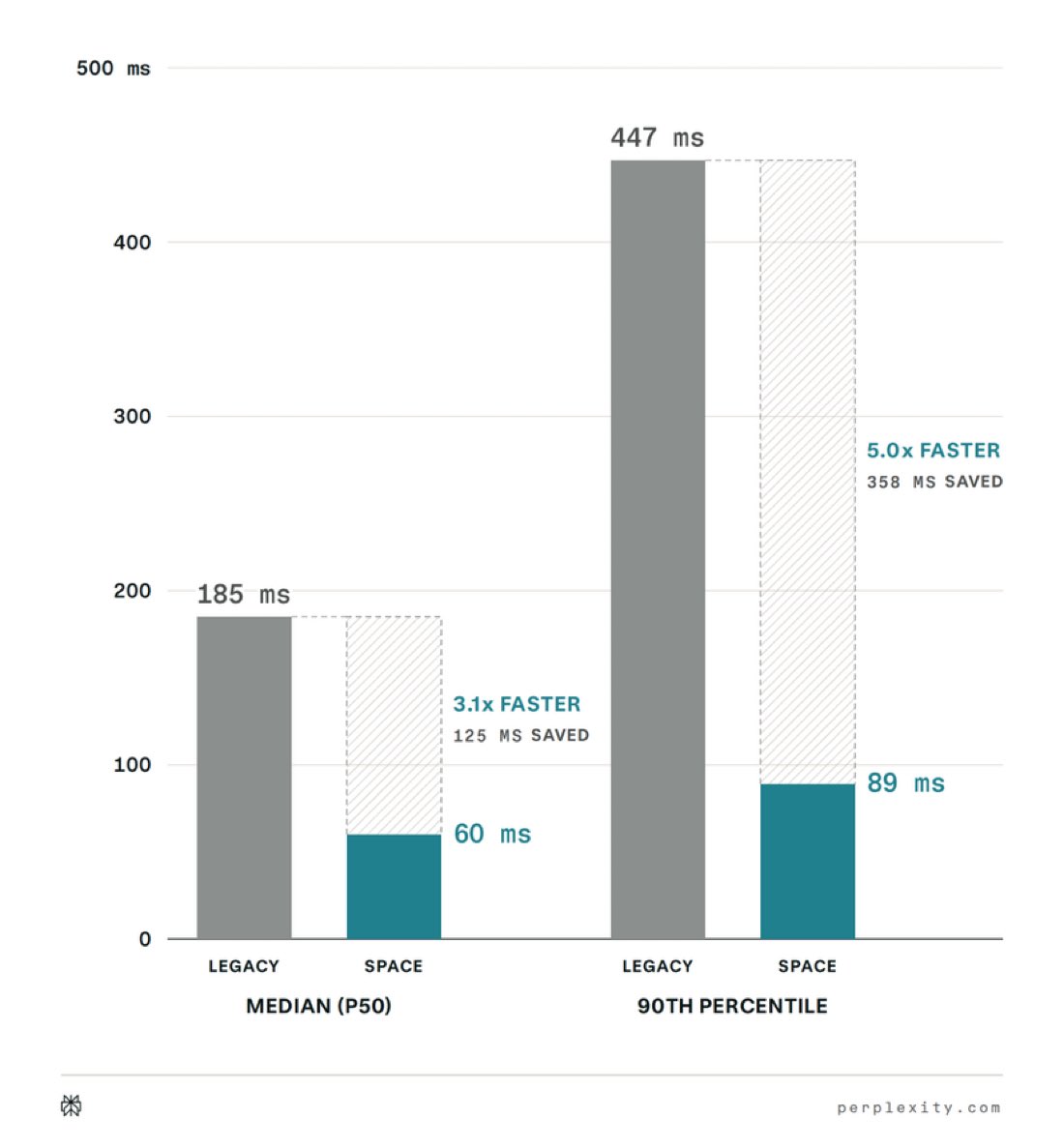
SPACE creates isolated environments for code, files and long-running agent sessions — the runtime layer underneath Perplexity Computer. Since June it has carried 100% of Computer's production traffic, and Perplexity published the engineering write-up on building secure, efficient runtimes for agents that live longer than a request-response cycle.
● FOLLOW-UP
Srinivas: 5x Faster Tail Latency After Dropping Third-Party Sandboxes
When Computer rolled out in February it ran on an external sandbox provider. Today all traffic runs on SPACE — with tail latency five times faster, per CEO Aravind Srinivas.
● ROBOTICS
A Robot Model with Five Minutes of Muscle Memory
8,000 timesteps of context at constant inference cost — three orders of magnitude past the norm.
Jim Fan's team scaled a robot policy model natively to 8,000 timesteps of context — roughly five minutes of continuous muscle memory — without inference costs growing. Robot policies have historically lived a few frames at a time, under a tenth of a second, instantly forgetting what just happened. Pushing memory three orders of magnitude changes what a manipulation policy can plan and recover from.
GPT-Live Learns to Multitask Mid-Conversation
The model keeps a conversation going while checking flights, pulling local weather and shaping an itinerary in real time — parallel task execution folded into live dialogue.
Claude Code Artifacts Can Now Call MCP Connectors
Dashboards and apps that fetch data and take actions per viewer, on demand. Available on Pro, Max, Team and Enterprise plans; not on publicly shared artifacts.
Official Ollama Extension Lands in VS Code
Local and cloud Ollama models integrate into VS Code chat: auto-discovery of local servers, pulls for models like qwen3.6 and kimi-k2.6:cloud, sign-in for cloud inference.
Codex Rounds Out: GPT-5.6 Ultra Mode, Multi-Agent Parallelism, Full PR Workflow
Computer and browser operation, app-screenshot understanding, inline code and doc edits, one-click Sites publishing and cross-project management — no longer just a tool that writes code, but one that decomposes, tests and coordinates.
MiniMax Hub Upgrade Adds ElevenLabs Music v2 and Seed Audio 1.0
One-stop AI workflows for short dramas, motion graphics and advanced camera control; local files stay on device and workflows save as reusable Skills that learn your style.
First vLLM Conference Set for Ray Summit, Aug 24–26 in San Francisco
Builders, maintainers and the vLLM community in one room, with NVIDIA, AMD, Google TPU, Intel, Meta, Red Hat and Hugging Face among the participants.
● POLICY
DeepMind: The Bottleneck in AI Science Is Real-World Validation
AI agents already propose hypotheses and design experiments — but testing ideas in the physical world is where discovery stalls. DeepMind's new essay maps the growing validation bottleneck and lays out four priorities for policymakers.
● ECONOMICS
DeepSeek's V4 API Gross Margin: 70–80%
Teortaxes revisits Liang Wenfeng's old pledge "not to subsidize, nor to reap excessive profits" against reported 70–80% margins on V4 API access — "that's 'slight'," he deadpans, calling Dario "one hell of a humanist" by comparison.
● MILESTONE
IMO 2026: Perhaps Humanity's Last Edge in Olympiad Math
The International Mathematical Olympiad opens within two days. Researcher Hieu Pham suspects it may be the last time humans hold an advantage over AI at mathematical olympiads.
With ChatGPT Work and Sol, I'm finding it incredibly joyful to just ask any question about the business and have it be thoroughly researched and answered. I have so many questions I wouldn't have bothered asking because they would be too burdensome to answer.
● EDITORIAL VOICES
Simon Willison: If You Know How to Write the Code, Delegate the Typing
Against the persistent claim that "if you know how to write the code, it's faster to write it yourself," Willison argues the exact opposite: if you already know how to write it, you gain nothing from doing the typing — outsource that to a coding agent and spend your judgment where it matters.
Codex in Chrome Turns a Request into a Go-Live Plan
Builds a checklist from a form, pulls context from Drive, Slack and local files, flags follow-ups, updates the portal and drafts the reply. You make the final call.
vLLM V1 Connector Makes Decode Pluggable
With prefill and decode disaggregated, TileRT paired vLLM prefill with its latency-optimized decode engine through the V1 connector interface — swappable per workload.
Blackwell Serving Recipes, Day-0 Performance
A cookbook of validated launch commands and tuning for Inkling on NVIDIA Blackwell, covering multimodal, reasoning and tool-calling usage.
MOSS-VL-Realtime: 11B VLM for Live Video Streams
Ask questions at any point in a live stream; the model keeps watching while it answers and revises as the scene changes. 256K context, day-0 in SGLang.
Modal's DFlash Speculator Outruns MTP
A trained DFlash draft model that beats native multi-token prediction for speculative decoding — a straightforward boost for Inkling inference speeds.
Pretrained MLLMs Work as Zero-Shot Reward Models for Text-to-Image
"Read It Back": multimodal LLMs can judge generated images without fine-tuning, improving text-to-image quality as off-the-shelf reward models.
Benchmark Hill-Climbing Is Becoming AI's Own Job
Arvind Narayanan sees upside — humans freed for judgment-heavy, non-verifiable research — but warns it will break peer review even further.
Two Years On, Reasoning Models Still Hallucinate Crossword Answers
Ethan Mollick revisits his o1-preview crossword demo: strong planning on hard clues, yet the model still invents words that don't exist.
Japan's Biggest Banks Build AI Factories with NVIDIA
Mizuho, SMFG, Rakuten Bank and MUFG NICOS move from evaluating AI to building infrastructure for it, on Nemotron open models and the Agent Toolkit.
NVIDIA Metropolis Ships 80+ Open Agent Skills
Synthetic data generation, model fine-tuning, deployment and real-time insight — production vision agents driven through natural language instead of thousands of developer hours.
Synthesia Dubbing 2.0: Better Lip Sync, 450 Free Minutes
Improved lip sync in complex scenes, higher-fidelity voices and translations that keep their timing, with instant transcripts included.
BaoCut's Loop: Agent Skill Prototyping + Claude Code Preview
dotey designs prototypes with the open-source baoyu-design skill, then previews and adjusts in Claude Code's built-in browser — Opus 4.8 suffices, no Fable 5 needed.
Codex Micro Keyboard Debuts
kbd-1.0-codex-micro, built with work louder: mappable buttons, a joystick and pinned chats in view. Limited run.
Codex Passes 8M Weekly Actives
Up from 7 million just days earlier, per op7418's screenshots — with usage resets arriving faster too.
MiniMax M3 Takes #7 on Long-Horizon Terminal-Bench
First place among open-weight models on the long-horizon terminal benchmark.
Sol Pro Fails the 1,025-Pokémon Crossword, Five Times
goodside's clue-free grid defeated ChatGPT 5.6 Sol Pro in every attempt — at best 145 answers in 33 minutes.
Ask for Software Instead of Searching for It
Mollick had GPT-5.6 Pro plan a Stream Deck controller for Codex; Codex built it, took over the computer and installed it.
OpenCode Desktop Now Runs with Ollama
Top open models plug straight into the desktop coding agent via local Ollama.
Step 3.7 Flash Arrives on Baseten
Built for real-world agent workflows: native multimodal understanding, reliable tool use, production efficiency.
Vidu S1: Real-Time Talk with Pets and Characters
Imagined conversations become live interactions with expressive voices and natural dialogue.
Cohere's Expedition Tiny Aya Goes Global
Children's education, multilingual AI safety and translation for under-resourced languages, mentored by Cohere Labs.
Brockman: 6x Price Efficiency with Sol for Frontend Dev
React and frontend workloads see a sixfold cost-efficiency gain, per gdb.
Delangue Floats an Open-Source AI March in SF
The Hugging Face CEO asks whether next week calls for a meetup — or a march — in support of open-source and local AI.
Teortaxes Pencils In 53–54 AA for Kimi K3
An optimistic pre-release call on the Artificial Analysis index for Moonshot's next flagship.
Continued Pretraining and RL Can Degrade Factuality
Across Gemini, GPT and Opus series the trend holds — but reportedly not for GLM-5, MiniMax or Xiaomi. Different regimes exist.
Seedance 2.5 Previews Impress
If the public release is anywhere near this good, venturetwins expects a massive shift to AI-generated video for almost every use case.
MiniMax Takes the SIGGRAPH 2026 Stage July 22
VP Leanna Ren on how native multimodal models connect understanding across modalities for richer creative workflows.