Anthropic Raises $6.5 Billion Series H at $965B Valuation
The largest pure AI lab funding round in history reshapes the frontier model landscape. Altimeter Capital, Dragoneer, Greenoaks, and Sequoia lead as Claude demand surges worldwide.
Anthropic has closed a $6.5 billion Series H funding round at a staggering $965 billion post-money valuation, led by Altimeter Capital, Dragoneer, Greenoaks, and Sequoia. The round marks the largest single capital raise for a pure AI research and product company, cementing the lab's position as one of the most heavily capitalized private technology entities in history. The company said the investment will directly fund expanded research capacity and infrastructure to meet what it described as rapidly accelerating demand for Claude, its flagship AI assistant. The raise comes amid an intensifying arms race among frontier labs, with competitors including OpenAI, Google DeepMind, and xAI also pouring billions into compute, talent, and next-generation model training. Industry analysts noted the valuation reflects a market belief that the leading AI platforms will capture disproportionate value as enterprises shift from experimentation to production deployment. Anthropic has consistently positioned itself around safety research and constitutional AI principles, a narrative that appears to be resonating with institutional investors seeking exposure to frontier AI while hedging against catastrophic risk scenarios.
Claude Opus 4.8 Ships With Sharper Judgment
Anthropic launched Claude Opus 4.8, building on the Opus 4.7 architecture with sharper judgment capabilities, greater honesty about its own progress and limitations, and measurably stronger reasoning across coding, mathematics, and long-context analysis. Early adopters including Cursor, v0, Perplexity, and Claude Code made the model available on launch day, signaling broad ecosystem readiness. The model demonstrates improved persistence on difficult multi-step tasks and more efficient token usage compared to its predecessor, according to initial benchmarks shared by integration partners.
SpaceX Builds AI Training Stack in Pure C
Elon Musk revealed that SpaceX has nearly completed version 1.0 of an in-house AI training stack written entirely in C, engineered to exact-map onto 220,000 GB300 GPUs with 800G NICs. The system makes heavy use of pipeline parallelism and runs as close to bare metal as possible, potentially delivering dramatic speed improvements over JAX-based workflows for large-scale training runs. The disclosure suggests SpaceX is building serious internal AI training capability, potentially for autonomous driving systems and robotics applications tied to the company's broader ambitions in AI-powered physical systems.
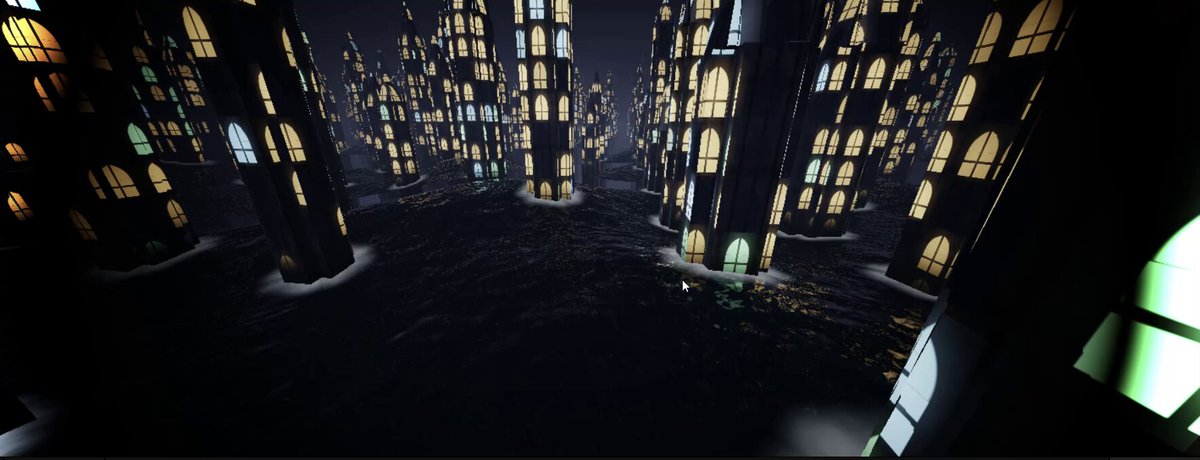
Opus 4.8 Generates Stunning Shader Art in a Single Prompt
Ethan Mollick demonstrated Opus 4.8's one-shot generation capability with a striking example: a single prompt produced a complex shader depicting an infinite city of Neo-Gothic towers partially submerged in a stormy ocean with large waves, driven entirely by mathematical functions. The result showcases the model's ability to translate abstract creative intent into executable code without iterative refinement, a capability that hints at broader applications in procedural content generation and creative coding workflows.
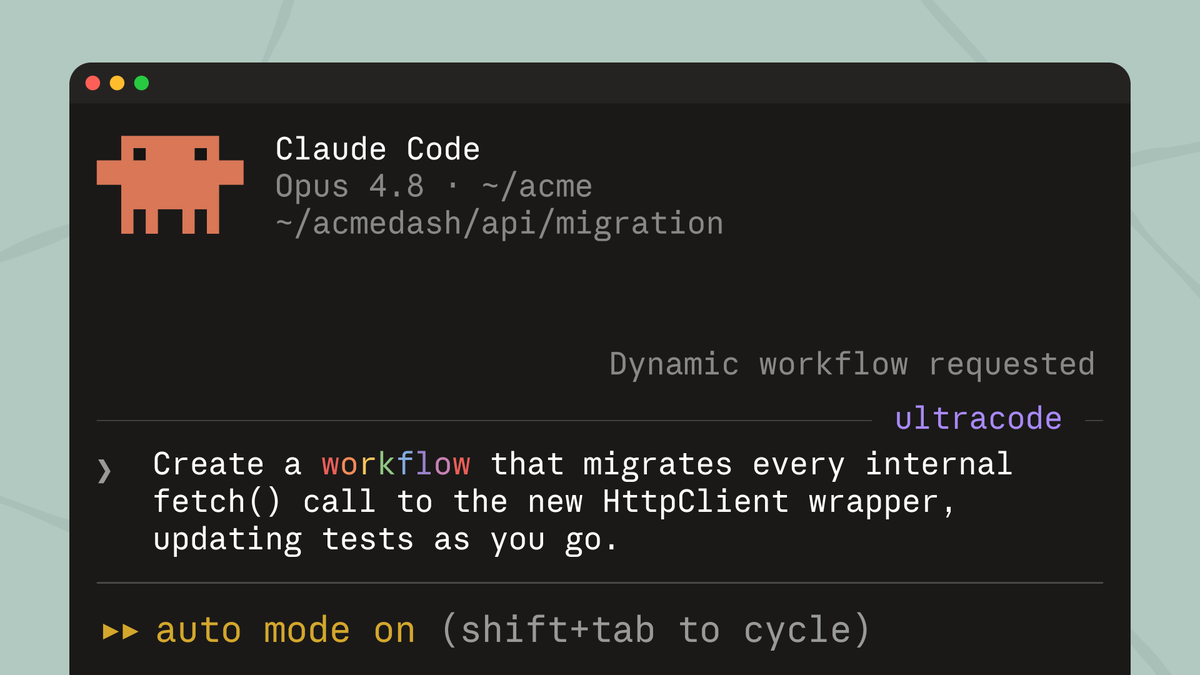
Claude Code Launches Dynamic Workflows
Claude Code introduced dynamic workflows in research preview, enabling Claude to write orchestration scripts on the fly and spin up coordinated fleets of parallel sub-agents for complex multi-step tasks. Users can invoke the feature by including the word "workflow" in any prompt.

Luma Creative Agents: Full-Process AI Design Assistant
Luma unveiled Creative Agents that assist throughout the creative process from planning, generation, and iteration to refinement, maintaining context continuity across long sessions. A demonstration short film project was built entirely from scratch using image and video generation tools guided by the agent.
Visa Makes Strategic Investment in Replit
Visa made an undisclosed strategic investment in Replit, partnering to integrate Visa payment products into the coding platform. Over 1,000 Visa employees already use Replit for prototyping, and the partnership aims to enable developers and AI agents to accept customer payments directly within the platform environment.
Mistral AI Deploys Enterprise Solutions at Airbus, BMW, EDF
Mistral AI announced at the AI Now Summit in Paris that its industrial AI solutions for aerospace, automotive, energy, and scientific applications are now running in production at Airbus, BMW, and EDF. The deployment signals growing traction for European AI in heavy industry sectors.
Google Nano Banana 2 Series Now Generally Available
Google released Nano Banana 2 and Nano Banana Pro, its strongest image generation models to date, now generally available to developers. The models represent Google's latest push into AI image synthesis following the earlier Nano Banana family.

FLUX Virtual Try-On: Sub-4-Second Garment Rendering
Black Forest Labs released FLUX Virtual Try-On, generating virtual clothing fittings in under four seconds while preserving person identity and garment details including logos, stitching, and fabric prints. The tool targets e-commerce and fashion with low latency at scale across thousands of products.
AI Storytelling Has a Fingerprint: 93% Detection Rate Achieved
The StoryScope paper analyzed 61,608 short stories across 10 narrative dimensions and 304 features, achieving 93.2% accuracy in distinguishing human from AI-generated fiction. Researchers found AI stories tend to over-explain themes and follow single-thread plots, while human narratives exhibit greater moral ambiguity and temporal complexity. Different models also showed distinct fingerprints, with Claude producing flatter event escalation and GPT exhibiting more varied structures. The study suggests that even when instructed to mimic different styles, AI-generated narratives retain identifiable structural patterns.
Diffusion Models May Be RNNs in Disguise
Sander Dieleman published a wide-ranging essay arguing that diffusion models can be understood through multiple equivalent lenses including autoencoders, deep latent variable models, score function predictors, inverse SDE solvers, flow models, recurrent neural networks, and autoregressive models. The piece traces these mathematical connections to reveal how diffusion models are not a standalone technique but rather a convergence point for several long-standing modeling frameworks, with the RNN interpretation offering particularly useful intuitions for practitioners.
"The potential speed improvement vs JAX for large training runs is enormous. Getting as close to bare metal as possible with 220,000 GB300s is a fundamentally different approach."
— Elon Musk on SpaceX's custom C-based AI training stack
v0 Launches High-Fidelity Figma Integration
v0's new Figma import reads layout, typography, components, icons, and images, converting static designs into functional interactive UI with unprecedented fidelity.
Replit Canvas: AI-Driven Visual Design Tool
Replit Canvas offers image, video, and audio generation with drag-and-drop editing and real-time collaboration for building websites, apps, and marketing assets.
Perplexity Computer Lands in Microsoft Office
Perplexity Computer is now available inside Excel, Word, PowerPoint, and Outlook, allowing users to draft documents, model data, build decks, and handle email via the side panel.
Cursor Publishes Developer Habits Report
Cursor shared findings on how AI is reshaping software development, drawing on what it describes as the world's largest dataset on AI-assisted coding across all model families.
Cursor Now Integrates Claude Opus 4.8
Cursor announced Opus 4.8 support, reporting significantly higher efficiency on CursorBench than Opus 4.7 and stronger persistence on hard multi-step coding tasks.

Grok Build 0.2.7: Sub-Agent Terminals and Better Vision
xAI released Grok Build 0.2.7 with /usage and /login commands, shared terminal sessions across sub-agents, and improved image understanding for coding workflows.
Huawei Adopts Stacked Small-Chip GPU Strategy
Analysts report Huawei is pursuing Cerebras-style redundancy with stacked small dies, potentially boosting wafer utilization from 20% to over 70% at SMIC's 7nm node. With 100K WPM capacity anticipated by end of 2026, millions of AI GPUs become feasible.
ESMFold2: Protein Structure in 9 Lines of Code
Meta released ESMFold2, a next-generation protein structure prediction model that achieves state-of-the-art results without multiple sequence alignment, requiring just nine lines of code to produce a full structure prediction. The model is fully open-source.
vLLM Powers NVIDIA Dynamo Snapshot Inference
vLLM now serves as the inference engine backing NVIDIA Dynamo's snapshot feature, restoring full worker process trees and GPU weights in under five seconds via CUDA checkpoint and CRIU with memfd parallel restore.
Repo2RLEnv: Turn Any GitHub Repo Into an RL Training Environment
Hugging Face released Repo2RLEnv, a tool that converts any GitHub repository into a runnable, verifiable coding environment built from real PRs and commits, enabling reinforcement learning training on software engineering tasks at scale.